March 18, 2026
LaSuite Docs at the French Presidency: How Digital Public Goods Enable Adaptable Public-Sector Systems
Author: DPGA Secretariat
Across public institutions, teams working on sensitive policy and data often struggle with fragmented document management systems that undermine collaboration, security, and efficiency. Within this context, the French Presidency’s DataLab faced persistent challenges in how documents were created, shared, and maintained. Version control was difficult, documents quickly became outdated, and reliance on email-based workflows slowed collaboration. These issues increased risks to data integrity and delayed decision-making, while strict security requirements and complex workflows underscored the need for a secure, autonomous, and collaborative digital workspace.
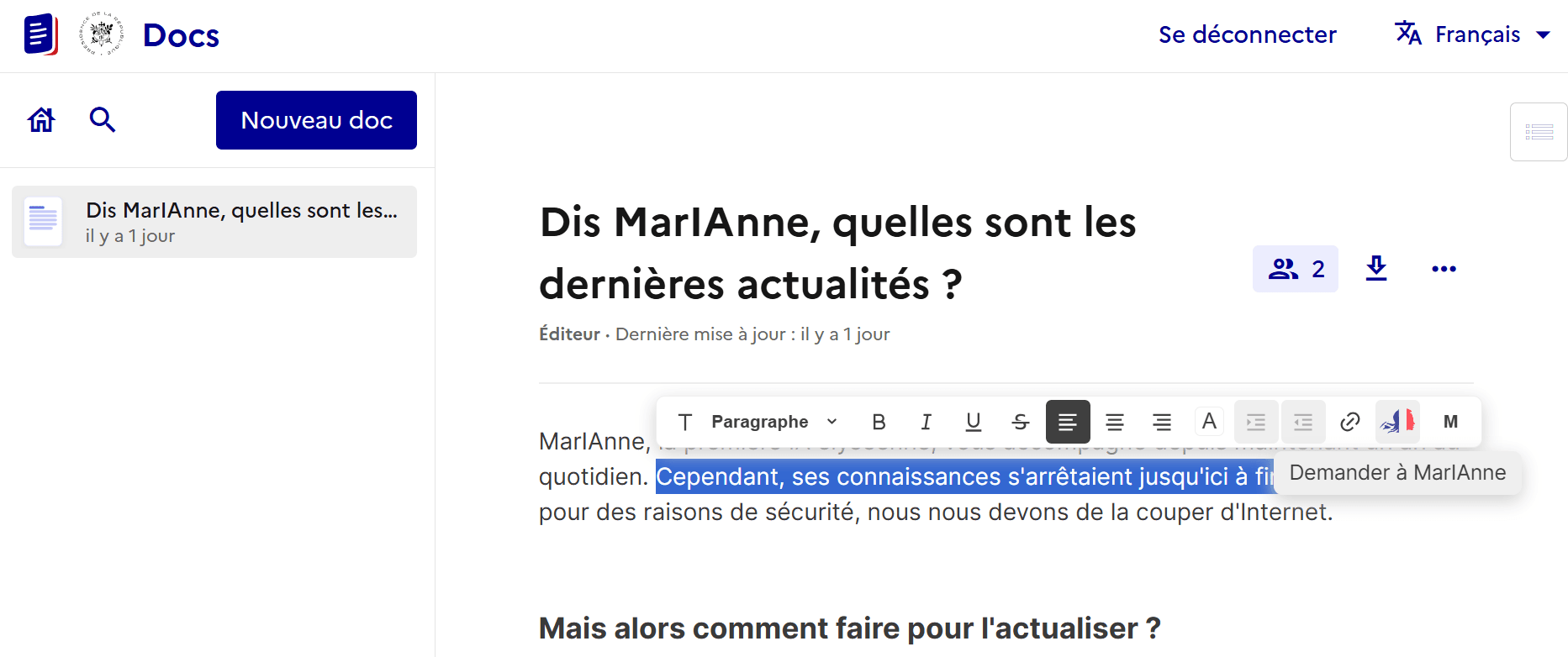
In 2025, the DataLab adopted LaSuite Docs, a containerised document editor recognised as a digital public good, as part of its broader digital transformation strategy. The tool was deployed using Podman, a secure container system required by the DataLab that allows applications to run within its own infrastructure rather than on external cloud services.
Its open codebase and documentation made it straightforward to adapt to the Presidency’s context. The DataLab customised the interface to align with its visual identity and integrated the tool into existing security and networking systems, without introducing new infrastructure. Limited configuration changes—such as proxy settings and backup arrangements—met the required operational and security standards, enabling a smooth rollout.
LaSuite Docs was selected for its alignment with the Presidency’s vision of a unified digital workspace. It complemented other LaSuite tools already in use, such as Grist, and fits within a broader ecosystem expected to expand to include LaSuite Drive, which is also a DPG. This harmonisation was key to eliminating silos and fostering a more collaborative way of working.
Following deployment, LaSuite Docs was rapidly adopted by presidential teams. Real-time collaboration replaced email-based workflows, reducing version conflicts and enabling simultaneous editing. The intuitive interface meant little training was required, while integration with the DataLab’s self-hosted AI assistant, MarIAnne, supported day-to-day work. Teams reported improved efficiency, with improved real-time collaboration, and access managed securely, making the tool accessible regardless of technical expertise.
LaSuite Docs demonstrated the practical advantages of adopting a DPG in a high-security environment. Its open-source design enabled transparency, adaptability, and cost efficiency, while autonomous deployment and interoperability with other LaSuite tools supported the Presidency’s objectives around digital sovereignty and institutional control. Together, this experience illustrates how DPGs can deliver secure, collaborative, and sovereign digital solutions at scale and strengthen public-sector workflows.
This content is part of the 2025 State of the Digital Public Goods Ecosystem Report, published by the Digital Public Goods Alliance in early February 2025. Learn more about the Alliance’s latest community highlights and explore the full report here.